Number Munchers: The History & Development of MECC’s Classroom Classic
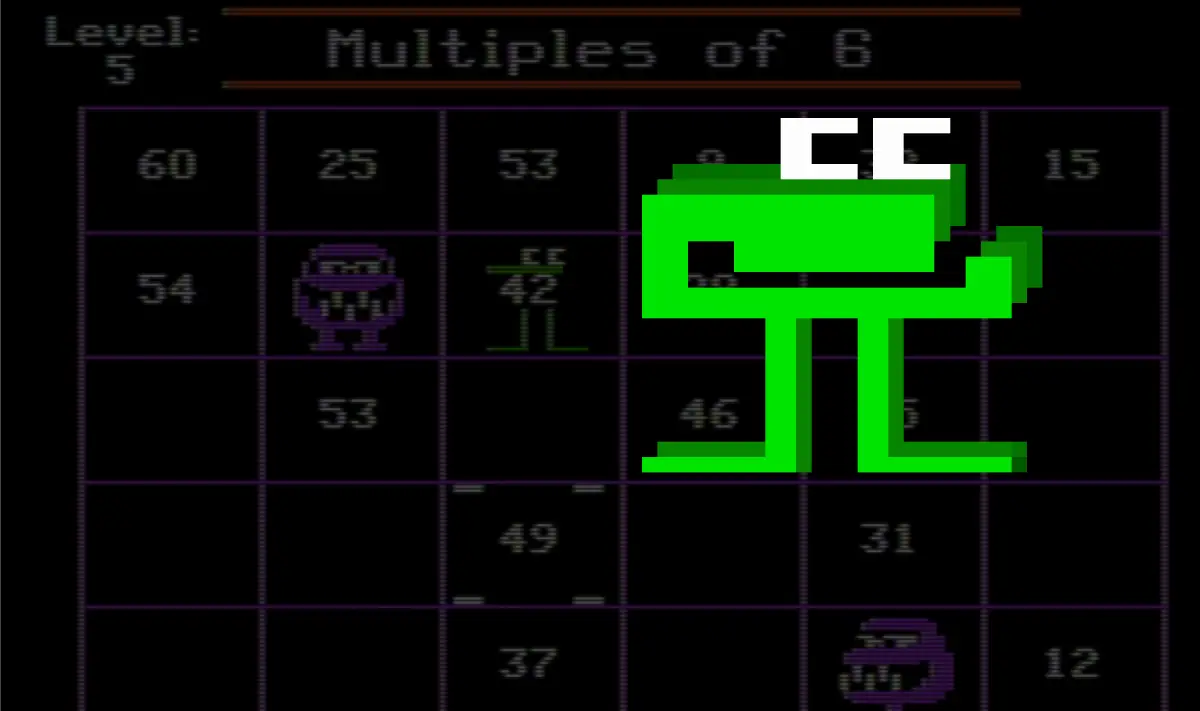
Number Munchers wasn’t found in arcades. It didn’t have TV commercials featured during Saturday morning cartoons. Yet, it became one of the most-played video games of an entire generation because it was sitting on the shelf of nearly every school computer lab in America.
For this post, I had the incredible fortune of corresponding directly with R. Philip Bouchard, the designer of Number Munchers (and the famous 1985 Apple II version of The Oregon Trail). What he told me completely changed my understanding of how this game came to be, including the surprising fact that although Word Munchers was released first, Number Munchers was actually the original game concept.
This is the story of how a state agency in Minnesota, the designer of The Oregon Trail, and a hungry green Muncher turned math lessons into one of the Apple II’s most beloved games.
MECC: The Government Agency That Made Video Games
You can’t tell the story of Number Munchers without telling the story of one of the strangest video game developers in history: MECC.
MECC (Minnesota Educational Computing Consortium) was created by the government of Minnesota in 1973 as a state initiative to bring computing to Minnesota schools. Early on, it was a giant UNIVAC mainframe that sat in MECC’s headquarters, which allowed schools all over the state to dial in through teletype terminals. Up to 435 users could be connected to the mainframe at once, and one of the most popular programs on the network was a text-based simulation about pioneers heading west: The Oregon Trail. Brought to MECC by an employee named Don Rawitsch (who had developed the game with Bill Heinemann and Paul Dillenberger while the three were seniors at Carleton College), the text-based version of the now classic was a huge hit. But MECC soon saw that the age of mainframes was dying and that a new technology was changing everything.
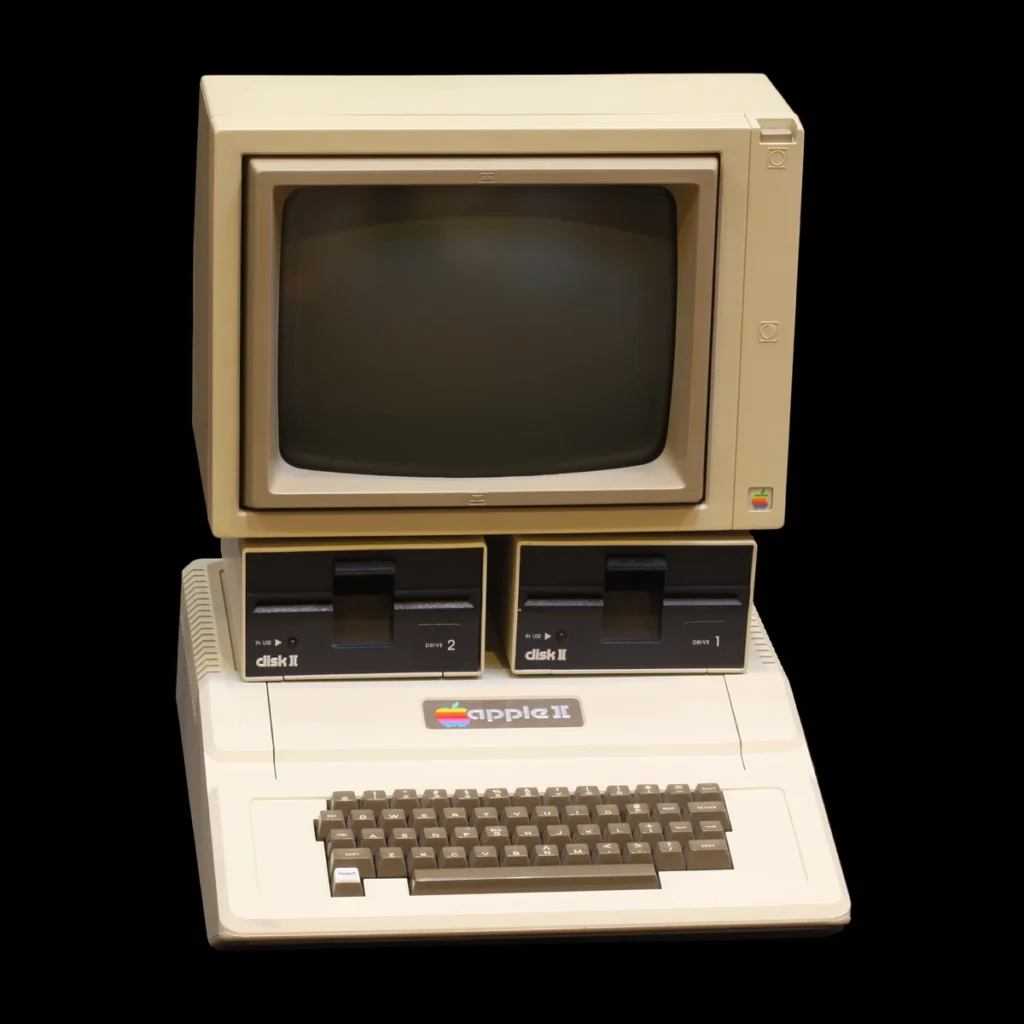
In 1978, MECC recognized that microcomputers were about to change the world, and after experimenting with the brand new Apple II, the organization put out a formal bid to supply computers to Minnesota schools.
Radio Shack submitted a non-compliant bid for the TRS-80 and refused to fix it. Apple, which at the time was still a scrappy underdog, submitted a proper bid and won.
The result? MECC placed an initial order of 500 Apple IIs — a massive number in a year when Apple sold fewer than 8,000 machines total — and became the largest reseller of Apple computers in the world, selling them to schools at cost. As a result, the Apple II became the school computer in America. Steve Jobs was so grateful that he personally gave the keynote at MECC’s 1982 education conference in Minneapolis. Jobs would later admit that schools buying Apple IIs was a huge part of what built Apple in those early years.
In 1984, the state reorganized MECC from a consortium into a publicly owned corporation — the Minnesota Educational Computing Corporation — with co-founder Dale LaFrenz taking over as CEO in 1985, selling its catalog of educational software to schools across the entire country. MECC had the machines, the distribution, and the audience. Now it just needed hits.
The Man Behind Number Munchers: R. Philip Bouchard
Philip Bouchard joined MECC in May 1981. As he told me, he occupied a unique position at the company: “I was the only person on staff with a dual background that included both software engineering and educational software design.” Officially a senior member of the technical staff working on Apple II software, Bouchard served as the official Analyst on MECC’s most technically challenging projects, advising both the lead designers and lead programmers.
In October 1984, he was handed the biggest assignment at the company: take the original text-based Oregon Trail, and its slightly updated version, Oregon, and completely redesign them as a graphical game for the Apple II. Over a ten month period, Bouchard served as the project manager, lead designer, and creative lead on the game. Programmer John Krenz and artist Charolyn Kapplinger joined him on the venture, along with team members Shirley Keran, Bob Granvin, and Roger Shimada. In 1985, Oregon Trail launched in the form many of us Generation X’ers and Millennials remember so fondly. The hunting mini-game, fording rivers, the landmarks (Whoo, Chimney Rock!), and of course dying of dysentery came out of that 1985 design.
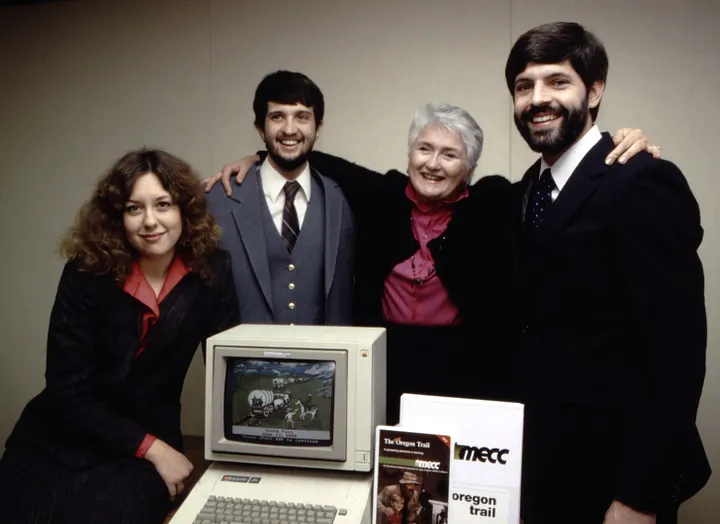
From left to right are Charolyn Kapplinger, John Krenz, Shirley Keran, and Philip Bouchard.
The Proposal: Number Munchers Comes First
Here’s where Bouchard’s firsthand account rewrites what we know of Word Munchers and Number Munchers. For years, the accepted story (repeated on Wikipedia and just about everywhere else) has been that Word Munchers came first, and Number Munchers was the spin-off. Technically true in terms of release dates, but the idea went the other way around.
In 1984, MECC did something very unusual for the organization: it solicited original product concepts from the entire staff. The open contest was for four product slots (out of the 24 total for the year). In August of 1984, Bouchard submitted a proposal that consisted of two densely packed typewritten pages, plus a hand-drawn sketch of how he envisioned the main screen. As he described it to me, “The concept for the proposal derived from the merging of several independent lines of thought and analysis, which I had been pursuing for several months.”
Bouchard’s proposal was for the game Number Munchers.
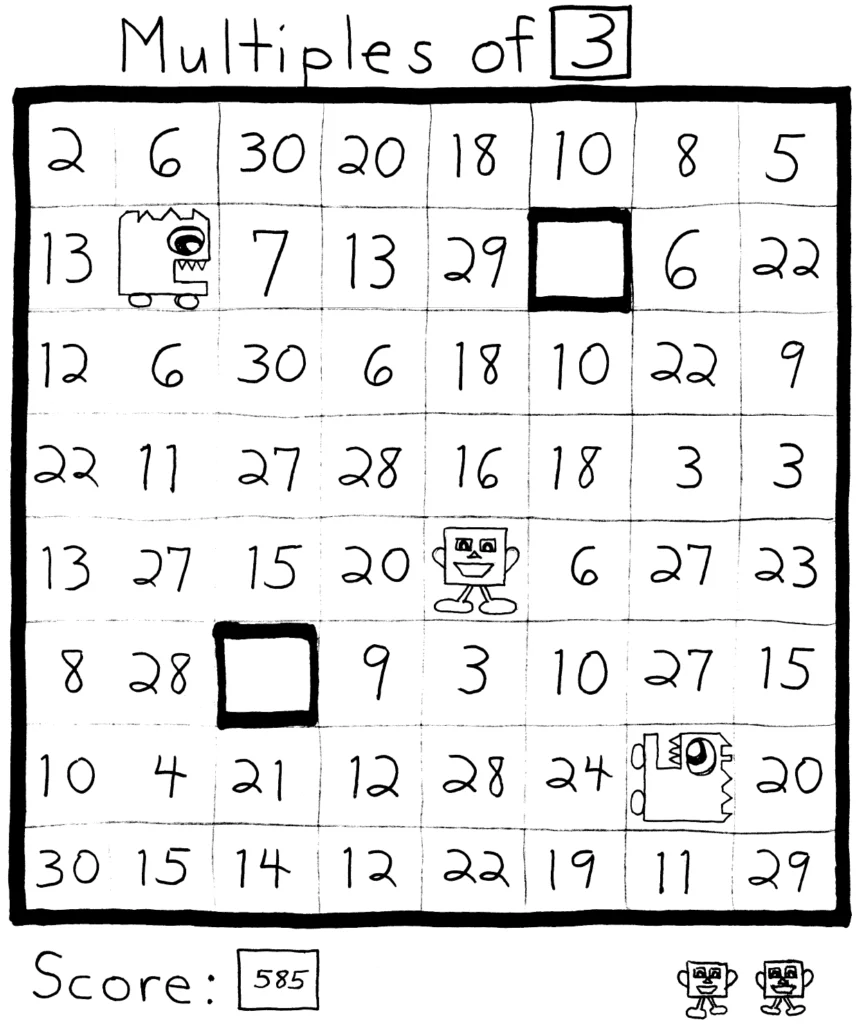
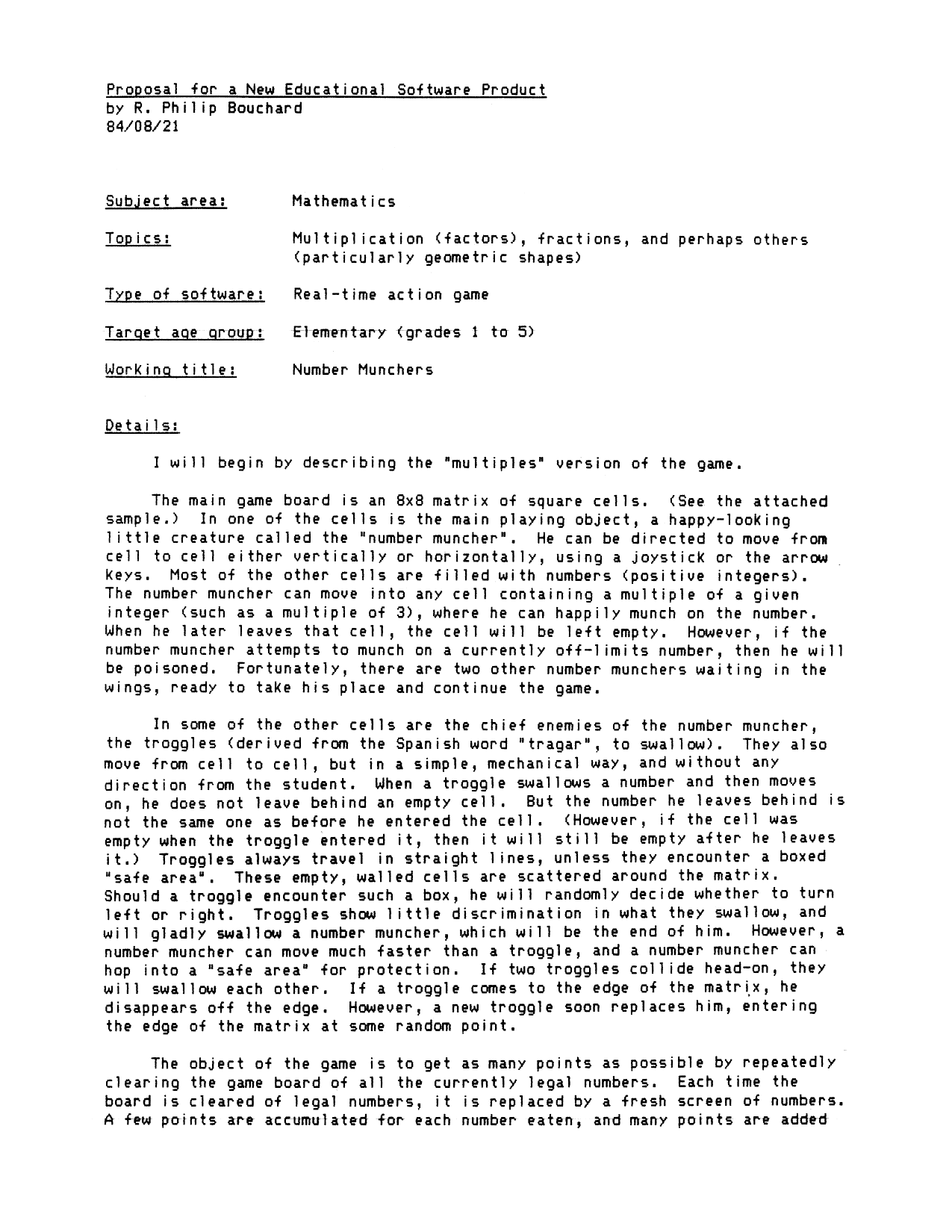
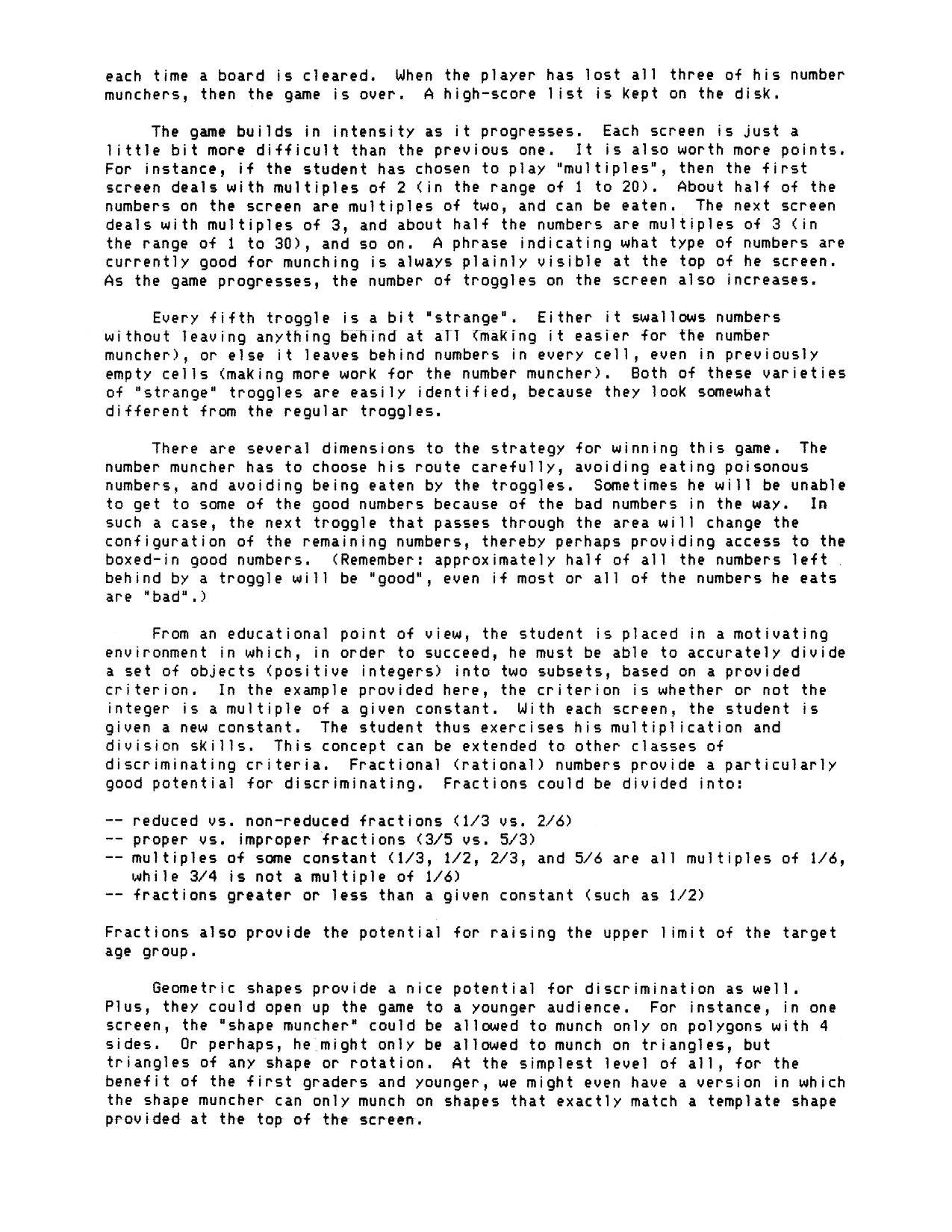
The concept won one of the four slots, and was scheduled to go into the 1985 release cycle. However, there was a catch.
“I was told to change the concept from math to language arts, because all the math slots were already taken,” Bouchard told me, “Therefore, somewhat reluctantly, I resubmitted the concept as Word Munchers, a product for practicing phonics.”
And so, Number Munchers became Word Munchers because of a scheduling conflict on MECC’s product calendar. The math game we all grew up on sat in a drawer for a year while its phonics twin was greenlit for development.
An Unprecedented Product
The Munchers proposal wasn’t just unusual in how it was selected. It was also unusual in how it would be built.
At the time, every MECC product was written primarily in Applesoft BASIC. Though the company kept a small team of assembly language programmers, they were reserved to build general-purpose tools such as subroutines for displaying text and rectangular color graphics on the Apple “hi-res” screen that the Applesoft code could call, the copy protection on MECC’s software, and other systems programming issues.
Bouchard’s proposal required something MECC had never done before: building the entire product in assembly language. That’s what it would take to get arcade-smooth character movement out of the Apple IIe.
“From experience, I knew quite well that arcade/action games needed to be programmed in assembly language. Anything programmed in Applesoft, even using assembly language subroutines, would be far too sluggish to perform properly,” Bouchard told me, “The entire product concept was quite unlike anything MECC had ever created,” Bouchard said. “And yet they approved the proposal.”
The hardware constraints were real. The Apple II’s hi-res screen offered a resolution of just 280×192 pixels and only six colors — with restrictions on which colors could even be placed side-by-side. (And it’s worth remembering how limited PC action games were in this era: smooth, console-style scrolling à la Super Mario Bros. wouldn’t arrive on PCs until id Software’s Commander Keen in 1990.) But a static screen with small animated characters was something the hardware could handle — if you wrote it in assembly.
To verify that everything would actually fit on the screen, Bouchard personally created Apple II mockups of the main screen.
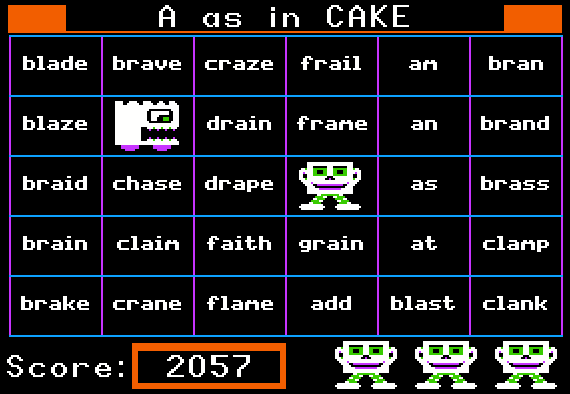
The design that came out of those mockups (a grid, rule at the top, score at the bottom) is the screen burned into the memory of every kid who ever sat in a computer lab in the late 80s or early 90s. However, you’ll notice one very big difference, which took shape once the official production of the game began.
Building Word Munchers
Because MECC’s annual cycle put both games on the same schedule, Bouchard spent late 1984 and early 1985 working on The Oregon Trail and Word Munchers simultaneously, on top of his usual duties. Both products were to be shipped in August 1985.
The team structure had a bureaucratic wrinkle. Because Bouchard was officially employed on the technical side of the company, MECC decided the official leader of the Word Munchers team should come from the educational side. Bouchard was initially paired with Gene Breault, one of his favorite designers, but Breault was overwhelmed with work, and his place was taken by Steve Taffee, a newly hired designer who, in Bouchard’s words, “quickly became a close friend.”
Taffee approved Bouchard’s screen design, but rejected his character design.
The job of designing the creatures went to Charolyn Kapplinger, MECC’s senior graphic designer (and Bouchard’s Oregon Trail collaborator), who created the now-familiar look of the big-mouthed green Muncher and the monstrous Troggles that chase it.
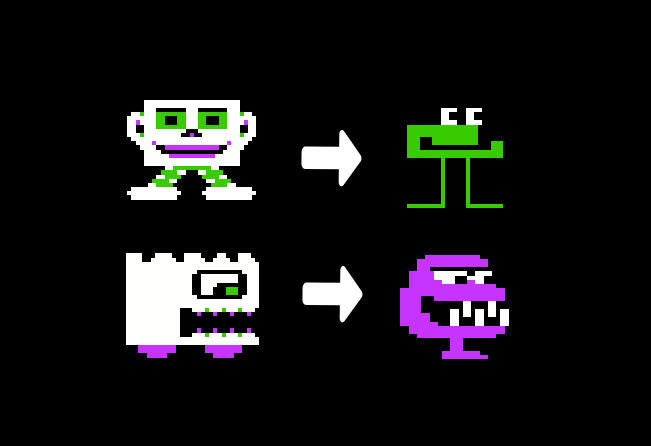
Bouchard then did the content research, designing how the phonics content would work, how the teacher options would function, and assembling the complete word lists for the product. Every design decision went through what he called a “triad”: himself, Steve Taffee, and Nan Leakley (who was the leader of the IBM software conversion team).
Together, the “triad” determined what was approved and what wasn’t. Bouchard outlined the gameplay details: the motions and interactions of every character on screen (which differed for each type of Troggle), and how both the game mechanics and the educational content would ratchet up in difficulty with each level. Taffee, as project leader, designed the teacher options screens and made judgement calls as needed as to what should and shouldn’t go into the game. Taffee then worked to bring everything the team had been working on together into an official design document.
Then, the programmers pushed back.
Ed and Harry
Mike Stein, Paul Wenker, and Roger Shimada, the assembly language programmers assigned to the project, took one look at the official design document and pointed out a problem: it didn’t contain nearly enough information to actually build the game.
So Bouchard went back to his desk and produced two long, single-spaced, typewritten documents written entirely in programming pseudocode. One laid out, in his words, “in excruciating detail how the multi-threaded mechanical processes actually worked, such as the movements and collisions of the characters.”
The other document presented the educational content in equally fine detail.
The team gave the two documents nicknames that stuck for the rest of the project: Ed and Harry. Ed was the educational content. Harry was the “hairy” gameplay algorithm.
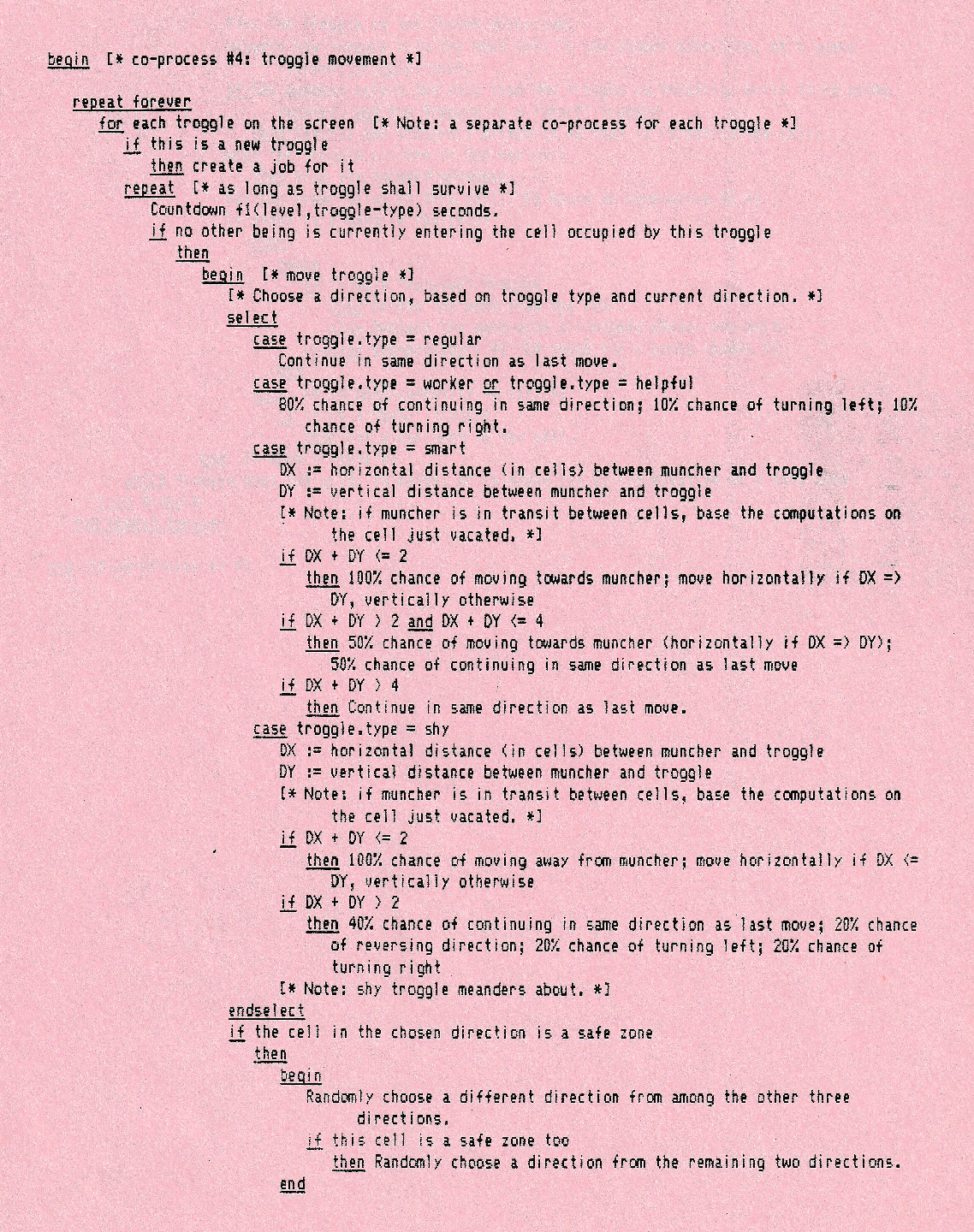
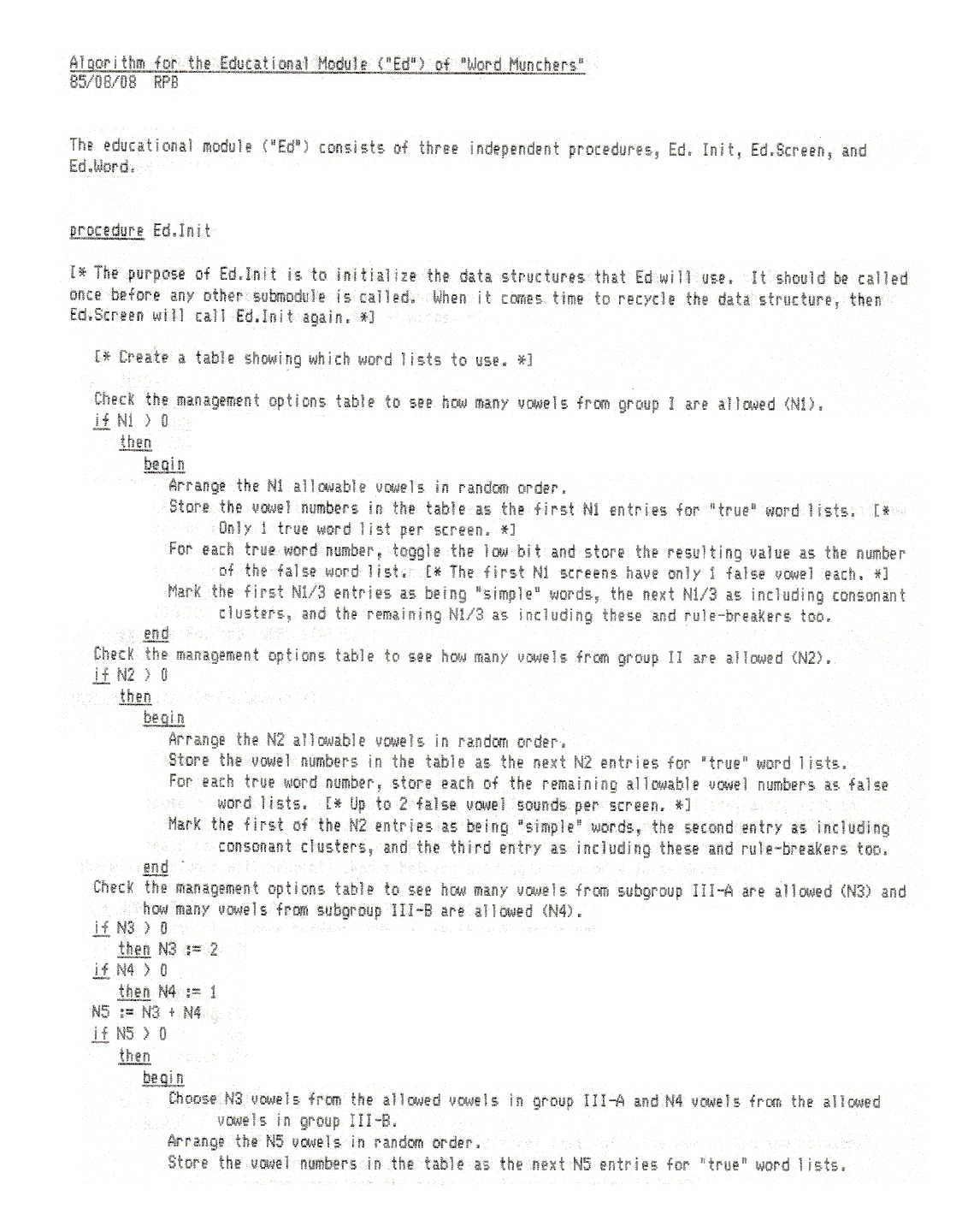
The same ‘Hairy’ algorithm was also used for Number Munchers.
Documents courtesy of R. Philip Bouchard, published with permission. Feel free to cite or embed with attribution and a link.
These algorithm documents provided essential programming details, while Taffee’s original design document remained useful for its screen layouts and high-level descriptions.
Munchers’ Iconic Sounds & Cutscenes
Bouchard also designed and programmed all of the sound effects himself, in assembly language. Every womp-womp-womp of a Muncher chewing, every Troggle collision — that was Bouchard. The sounds proved so popular that when MECC later created the Macintosh version, the staff didn’t compose new audio. They sampled the original Apple II sounds instead. Why mess with a great thing?
One last piece of the game wasn’t in Bouchard’s original proposal at all: the cartoon cutscenes.
During development, the team decided the player ought to experience a cartoon interlude after completing every third level as a little reward, just like the intermissions in arcade Pac-Man. This portion of the product was handed to Bill Way, who worked with Kapplinger on graphics and a second programmer on code. These cutscenes were programmed in Applesoft, not assembly.
2000 hours later…
As mentioned before, Bouchard was working on Munchers and Oregon Trail during the same development cycle between 1984 and 1985. At this point, a typical MECC title would take about 500 total hours of work across design, art, and programming of a title (though the actual amount of time varied). This limited budget was necessary because MECC needed to create 24 new Apple II products per year (plus port existing products to other platforms like the Commodore 64 and Atari).
For Oregon Trail and Word Munchers, two of the most ambitious products MECC had ever undertaken, the teams ended up spending around 2,000 hours on each of them. In Bouchard’s own words, “During that 1984-85 year, I clearly spent more time on Oregon Trail and Word Munchers than on anything else, but I also did a lot of other work at the same time.”
The Oregon Trail launched on July 31, 1985, but initially, MECC made the decision NOT to make it a product available for schools, and instead planned on selling it exclusively to the home market. Bouchard told me, “This left MECC with no obvious choice regarding which new product to feature as the headliner at MECC’s annual teacher conference in November. Therefore, it was decided that Word Munchers would be the featured product.” However, there was yet another wrinkle in the plan: Word Munchers was pushed back due to the assembly developers not being available to start on the project until August, 1985. Luckily, the team had already completed the design of the game, cutscenes, and other aspects of development by that time.
So, Word Munchers was pushed out from the normal release date in August or September, all the way to November to coincide with MECC’s annual teacher conference.
With Oregon Trail completed, Bouchard and team had another three months before Word Munchers would be launched on November 1, 1985. From August through October of 1985, Word Munchers was finally built, tested, and refined. Bouchard told me, “I spent much of my time in August, September, and October (1985) working on Word Munchers.” It was during this time period that ‘Hairy’ and ‘Ed’ documents were created.
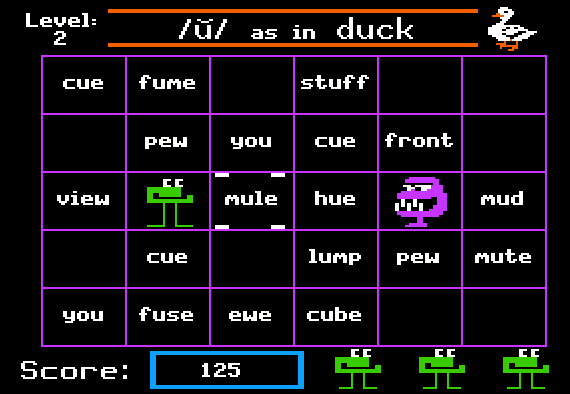
Word Munchers shipped on November 1, 1985. It was debuted at the MECC annual teacher’s conference, and according to Bouchard, “Word Munchers was a huge hit.”
Another interesting fact about Oregon Trail that played out at that time was it’s exclusion from the school market stoked anger amongst teachers and schools who had annual site licenses to MECC’s software. According to Bouchard, “MECC soon did an about-face, first releasing a school version of The Oregon Trail (same software, but in different packaging that included an extensive teacher’s manual), and then belatedly adding the product to the 1985-86 site license program – at no additional charge.”
The 2,000 hours spent on Word Munchers paid off. Teachers loved the lessons and ability to modify the software to fit their lesson plans. Students loved the phonics lesson wrapped in an arcade game. And Parents’ Choice handed it a Golden Award. MECC had found the formula for a hit and Bouchard’s original concept was still waiting in the wings.
Number Munchers Is (Finally) Created
In August 1985, as Word Munchers was nearing completion, MECC finally approved Bouchard’s original Number Munchers proposal; a full year after he first submitted it. Number Munchers was set for release in August 1986.
Development moved fast, because the hard problems were already solved. For the first three months of Number Muncher’s development, the team was actually finishing Word Munchers (which, in effect, was creating Number Munchers too).
The team reused the screen design and character design from Word Munchers wholesale. Harry (the gameplay algorithm) needed no significant changes. But Ed had to be rebuilt from scratch: an entirely new educational engine, swapping phonics rules for math rules. Bouchard also designed a fresh set of cartoon interludes, and Steve Taffee once again served as the representative of the design staff and official team leader.
Instead of finding words with a long ‘a’ sound, players now saw math rules displayed at the top of the screen, and had to munch every number or expression on the grid that fit the rule. Number Munchers shipped with five modes of play:
- Multiples – Given a number like 4, munch every multiple: 4, 8, 12, 16, and so on.
- Factors – Given a number like 12, munch its factors: 1, 2, 3, 4, 6, and 12.
- Primes – Munch only the prime numbers on the board. (Ask any 80s or 90s kid why they still remember that 51 isn’t prime. This game is why.)
- Equalities – Munch expressions that equal the target number.
- Inequalities – Munch expressions that don’t equal the target number.
Munch a wrong answer and you lost a life. Get caught by a Troggle, same thing. Clear every correct answer from the board and you moved on, with the rules getting harder and the Troggles multiplying as you increased levels.
Speaking of Troggles, each of the five types moved and behaved differently (remember, Bouchard’s Harry document specified every character’s motion in pseudocode), and each came with a cute Latin scientific name in the manual:
- Reggies (Trogglus normalus) – were the most basic of the Troggles and simply moved in a straight line
- Bashfuls (Trogglus timidus) – would move around the board but actively move away from Muncher
- Helpers (Trogglus assistus) – were ant-like Troggles that ate all answers they touch
- Workers (Trogglus laborus) – added or changed existing answers as they move around
- Smarties (Trogglus smarticus) – had big teeth and glasses, and they actively chased Muncher around the board
Now, students who would previously groan over having to spend 10 minutes working on a math sheet would be overjoyed to be doing the same problems for 30 minutes or more playing Number Munchers.
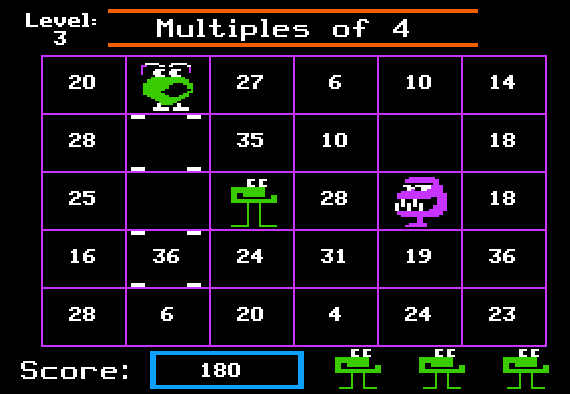
The Cartoons That Kept Kids Coming Back
Just as in Word Munchers, cartoon cutscenes played every third level. But for Number Munchers, Bouchard designed a whole new set. Once again, Kapplinger created the graphics and Bill Way programmed the cartoons.
Bouchard told me, “Each of the cartoons was supposed to be preceded by a short, funny title that set the stage for a bit of ‘Muncher history’. But due to a programming issue on the assembly language side, these titles never got displayed – and without the context of the title, some of the animations don’t make as much sense as they should!”
And this all makes sense, because some of the cutscenes are a little strange. However, when paired with their original titles, they make a lot more sense. The original Number Munchers cutscenes AND their original titles included:
- Sir Edmuncher Hillary climbs Mount Evermunch – A Troggle slowly climbing a mountain, only to have Muncher climb up the other side faster and plant a flag at its peak.
- William Tell Muncher shoots an apple off his son’s head – Muncher shooting an arrow at an apple on another Muncher’s head
- Munchzon Borglum creates Mount Munchmore – Muncher carving its face onto Mt. Rushmore
- Alex-muncher Graham Bell invents the telephone – A Troggle answering a phone call only to be prank called by Muncher
- Henry “Munchy” Ford invents the automobile – A Troggle chasing Muncher back and forth across the screen until Muncher gets in an antique car and speeds away, leaving the Troggle behind
- Thomas Alva Munchison discovers the light switch – Muncher stumbles around in the dark bumping into things until it pulls on a light switch to reveal the room strewn with broken furniture it knocked over
Another misconception online is that the Thomas Alva Munchison cutscene replaced a beauty contest scene. Bouchard confirmed to me that the cutscenes above were the originals in Number Munchers and that a beauty contest cutscene was NOT in the original version of the software.
Despite the programming issue, the addition of these screens still did two important things: First, it provided a quick break for students every third level. But more importantly, it made the game “sticky”. Kids would hear of a cutscene they hadn’t seen yet, so they would go back to the game over and over again to unlock it (admittedly, the dark room and car cutscenes seem to be much more rare than the other four scenes from my own experience).
Another thing that kept kids coming back was a chance to get a high score and be in the Hall of Fame. Of course, giving kids access to write anything they wanted in the game also meant teachers had the option to completely reset the Hall of Fame in case anything nefarious was written in it (and trust me, it was.)
Building Number Munchers for Teachers Too
Unlike most games that were (and are) created, MECC had two specific audiences: the players (students) and the teachers. Striking a balance between fun and learning was no small task. Most video game developers strive to just create something entertaining enough that players will want to come back over and over to it. But also creating something that made the players learn at the same time? That could be considered the Mt. Everest of gaming.
Bouchard’s design work on the original Word Munchers included a detailed plan for “how the teacher control options would function,” developed and approved through the same triad process as the phonics content itself. While the action on screen was geared to players, behind it were resources teachers loved.
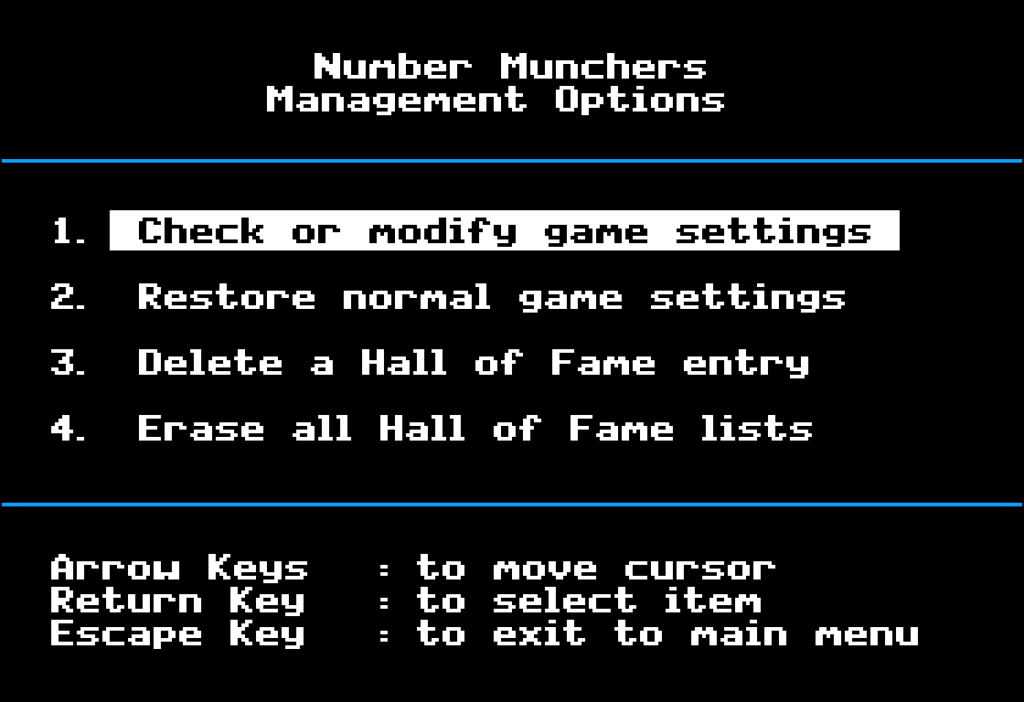
The School Versions of Word Munchers and Number Munchers shipped with teacher options that let educators tune the content to fit their lesson plans, such as allowing teachers to select the modes and difficulty ranges in the game. Printed instructional materials were also packaged with everything MECC sold to the school market. So any fourth grade teacher with zero computer literacy could adjust the game to fit their lesson plan.
Entering the secret command on the home screen (Ctrl + A) opened a teacher’s menu where the game could be customized to fit students’ abilities. If a teacher didn’t want to cover multiples all the way up to 20, they could set the maximum to 10. If they wanted to challenge students, they could move the minimums of each gameplay type up as well. And of course, resetting the Hall of Fame was always there for when “Seymour Butts” showed up on the leaderboard.
Number Munchers Launches Across America
The development of Number Munchers officially wrapped by the end of April 1986, but like all MECC releases, was timed to officially release for the Apple II at the start of the next school year. Number Munchers officially released in August 1986. The game did exactly what it was designed to do: make learning math fun. Soon, the game was in schools across America, and with commercial success came critical acclaim. It won top honors from Parents’ Choice, InCider Magazine, and Media & Methods. Along with Oregon Trail, Number Munchers became a cornerstone of MECC’s identity and the face of edutainment software across the country.
But it wasn’t only a hit in schools. MECC released two versions of the game: a School Version for classrooms and computer labs, and a Consumer Version for families at home. Both games were identical, the only difference was the packaging and instructions. Now parents who heard all about this amazing math game from their kids could buy the game and have it at home.
As Bouchard put it to me, the two games he’s best known for — Oregon Trail and Number Munchers — “became the cornerstones of MECC’s fame and its value when it was sold to private investors and later resold.”
The Legacy of Number Munchers and MECC
MECC dominated the Apple II educational market throughout the mid-to-late 80s, led by Oregon Trail and Number Munchers. In the early 1990s, MECC’s leadership wanted to continue to target the home market, but the software industry had changed a lot since the mid-80’s.
Bouchard says, “By the early 1990s, the design and development of consumer software was becoming more elaborate and expensive – and the Apple II was no longer the target platform.”
To keep up with consumers, MECC needed bigger budgets and more resources. The state of Minnesota wouldn’t be able to help with their growth, so in January 1991 the state sold MECC to a private investment group, North American Fund II, for $5.25 million. The now fully private company created more software, including updated versions of Number Munchers in 1990 for MS-DOS and Macintosh (the ones with Bouchard’s sampled Apple II sound effects), a 3D-styled Math Munchers Deluxe in 1995, and Oregon Trail II in 1995, which was very successful.
In October 1995, a year and a half after MECC had IPO’d, it was acquired by SoftKey (which would soon acquire the software firm The Learning Company and take on its name) for approximately $370 million in stock. However, not even the one-two punch of Number Munchers and Oregon Trail could save the future of the company. Mattel purchased The Learning Company in 1999 during the dot-com bubble, for a whopping $3.8 billion, making SoftKey co-founder Kevin O’Leary a very wealthy man. However, despite the high price tag, The Learning Company was not making any profit at the time — it was hemorrhaging tens of millions of dollars per quarter. Mattel sold the division at a massive loss barely a year later, and the acquisition has been called one of the worst deals in corporate history. As a result, what was left of MECC’s Minnesota operations was shut down in 1999.
Number Munchers and MECC have gone dormant. But dormant doesn’t mean forgotten. Number Munchers is instantly recognized by Generation X and Millennials alike who sat in computer labs and loudly smashed the spacebar to munch factors of 2 while trying to beat their friend’s high score. Today, Number Munchers is available to play online, ready for a new generation to learn their multiples while being chased by those darn Troggles.
Philip Bouchard left MECC shortly after Number Munchers was released. He has since published You Have Died of Dysentery: The creation of The Oregon Trail – the iconic educational game of the 1980s and currently writes a blog at https://www.philipbouchard.com/. He would later recount all of the games he made, but “none of these are as much fun as Oregon Trail or Number Munchers.”
Thank you, R. Philip Bouchard!

This post would not have been possible without Philip Bouchard’s generosity in answering my myriad of questions about the development of Number Munchers and his time at MECC. His answers were incredibly thorough, and being able to get his first-hand account of those days made this post unique to any other post about Number Munchers that I’ve ever seen. Please check out his new book, “The Stickler’s Guide to Science in the Age of Misinformation” and his website.
References:
- Retro Gaming Geek Interview with R. Philip Bouchard (August 2026)
- Number Munchers Wikipedia page
- Word Munchers Wikipedia page
- Bouchard, R. Philip. “How I Managed to Design the Most Successful Educational Computer Game of All Time”, The Philipendium
- ANTIC Interview 369 – Philip Bouchard, The Oregon Trail (Atari 8-bit Podcast, 2017)
- “How You Wound Up Playing The Oregon Trail in Computer Class,” Smithsonian Magazine (2016)
- The Oregon Trail, MECC, and the Rise of Computer Learning – The Strong National Museum of Play / Google Arts & Culture
- MECC, The Company that Launched Educational Gaming – The Strong National Museum of Play
- Minnesota Educational Computing Corporation (MECC) collection finding aid – The Strong
- Number Munchers at MobyGames
- Number Munchers (v1.2, 1986) at the Internet Archive
- OREGON (Trail): BASIC Game Design from the Teletype Era, ℤ→ℤ blog
- Kevin O’Leary: He’s not a billionaire, he just plays one on TV – Report on Business Sept. 28, 2012