Dan Geisler: The History and Career of a Road Rash Legend
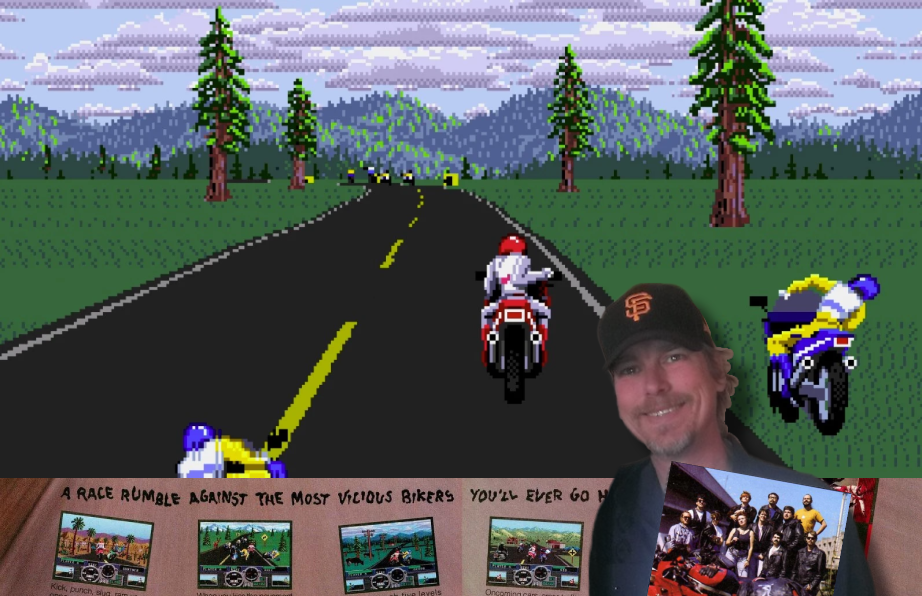
Dan Geisler’s career in game development has spanned nearly 40 years. In that time, he worked for many titans of gaming: EA, Sega, Midway, Activision, just to name a few. Self-described as “The Legendary God of Video Game Creation, and humility,” he had his hands one some of the biggest games ever made, and marched to the beat of his own drum. I had the privilege of interviewing Dan Geisler for this Developer Deep Dive in August and September, 2026.
Geisler Lands a Big Gig Right Out the Gate
At the beginning of 1987, Dan Geisler saw an ad in the San Francisco Chronicle for a video game programmer. He was finishing up his degree in management information systems (MIS) at California State University that year, and being an avid video game fan, he decided to apply.
Geisler’s degree wasn’t purely programming. MIS is the combination of programming and business. Despite starting school as a computer science major, Geisler decided to switch majors about halfway through, but the appeal of programming stayed with him. Geisler says, “In my business classes I just messed around. We had just gotten the first PCs, and I was doing a lot of goofing off in class, programming.”
That love of programming was helped along by his wife’s bother-in-law, who was working at HP and was getting all of the ROMs for the Atari 2600 and then burning them for Geisler. “I was a big video game fan — I never thought I’d get a job doing it. But from my first computer class, I just fell in love with programming.”
At home, Geisler had a Commodore 64, which he wrote a sprite editor and music editor on. After applying for the job he saw in the San Francisco Chronicle, he got a call to come in to interview at the gaming company.
That gaming company: Spectrum HoloByte.
With his wife and 3 year old daughter in tow, Geisler went to the small Spectrum HoloByte office to try to land a gig in gaming. He showed them his sprite editor and music editor, which they liked. Outside the interview room, his wife and daughter were chatting things up with some of the girls in the office. “The girls in the office really liked my daughter. Maybe that’s what got me the job, or made me memorable anyway. But it was fun.” The job was his.
The Spectrum HoloByte office was above a dress shop at 3rd and Bryant in San Francisco (a neighborhood later dubbed “Multimedia Gulch”). The first title Geisler was assigned was a Commodore 64 port of the box-pushing puzzle game Sokoban. The game launched in 1988, just as another project opened up at Spectrum HoloByte. The company had acquired the rights of a Soviet Union game and were going to bring it to the United States.
That game: Tetris
Developing Tetris
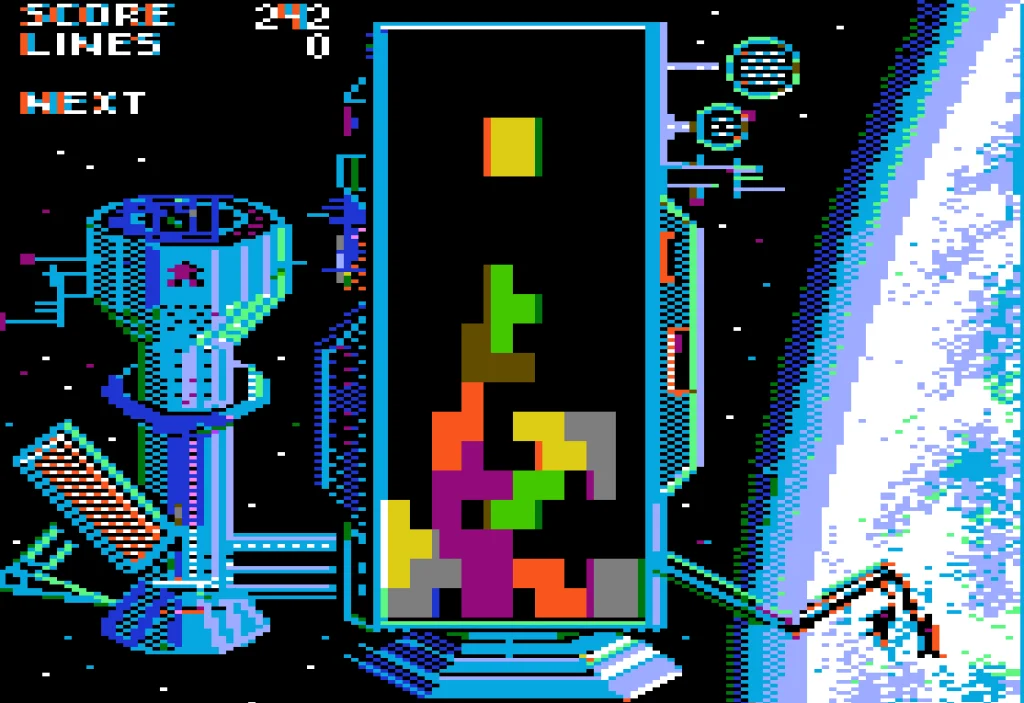
While the most recognizable version of Tetris is arguably on GameBoy, the game was ported to nearly every available platform at the time. At Spectrum HoloByte, Geisler was given the task of programming the Apple II version entirely himself. He was also tasked with helping build the UI for the more advanced Mac version of Tetris.
Vette!
After porting Tetris to the Apple II, Geisler was handed his first original project.
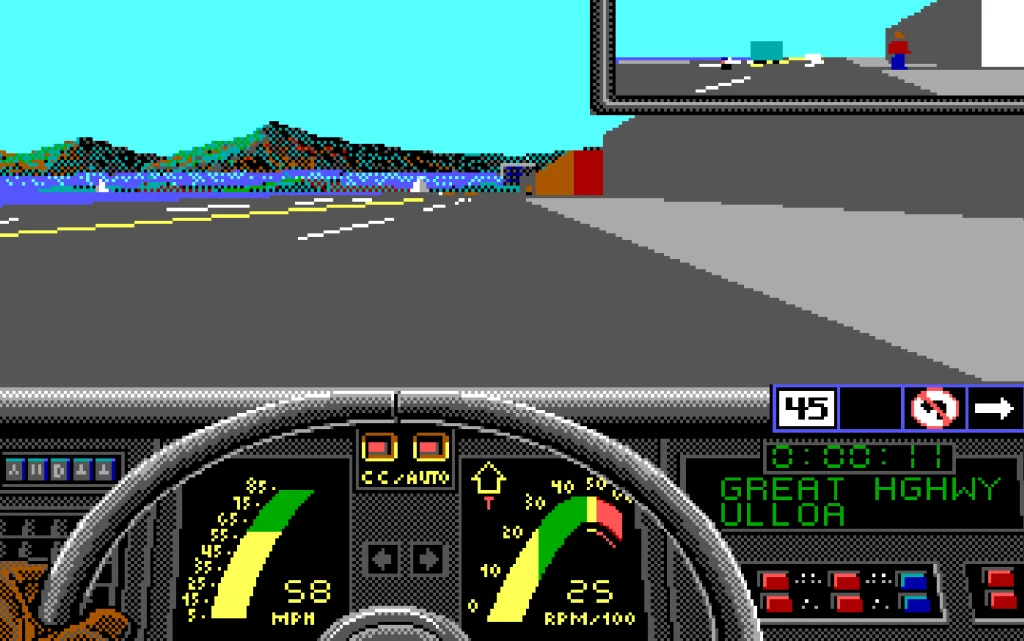
“I got to do my first real game design with Vette!, which was one of the first open-world driving games,” Geisler told me.
Aside from Vette! being one of the first open-world driving games, it was also one of the first head-to-head racing games connected via modem. The game was a simulation, where you drove your Corvette around San Francisco. It featured 3D graphics, a full dashboard, a map of San Franscisco, and adjustable camera angles as you drove. It also gave you the ability to speed down the streets of San Fransciso, including over bridges, under tunnels, and even pull over at gas stations to repair your car. Drive too crazy, and the police would soon be in pursuit. If you got pulled over, you could use one of the excuses in the game to get out of it, unless the reckless driving you were doing included running over a pedestrian.
Wait, an open-world racing game where you could speed through a city, run from the police, and run over pedestrians? Hmmm…that sounds familiar. We’ll come back to that.
The game also came with a 142 page manual, which featured many of the landmarks in and around San Francisco.
At the time, Vette! was a technological marvel, and was nominated by PC Magazine for Best Technical Achievement on a PC in 1989. Compute! magazine made Vette! the Compute! Choice in November and said, “Vette! surpasses other driving simulations in its scope and realism.”2
The success of Vette! was to be a spring board for Geisler, but not at Spectrum HoloByte.
Moving on to EA
Spectrum HoloByte was focused on the PC market, but Geisler wanted to get into console gaming. But he thought that could come after he made his next game. He pitched an idea similar to Vette! but it leaned far more toward arcade fun than sim realism. The game idea was for Stunt Driver.
He began designing Stunt Driver after the launch of Vette!, but the development would be short-lived.
“[Spectrum HoloByte] gave Stunt Driver to my assistant programmer and let him do the project. So I was kind of pissed about that. I told them, ‘I need a raise to get up to $40,000 bucks or I’m going to go work for EA.’ They didn’t give me the raise, so I gave EA a call, got an interview, and got hired by Trip Hawkins. And that was it. I quit Spectrum HoloByte.” Geisler recalled.
And for Geisler, the move to EA would bring another challenge. The office was 100 miles from his house. Instead of upending his family, he opted for the commute. “I never felt like I was working at all, even though I was commuting 200 miles a day.”
For EA, the timing couldn’t be better. The company up until that point was a well-known publisher of games, but hadn’t done their own game development. But that was changing. They were already working on a port of the Apple II hit, John Madden Football, (originally developed by Bethesda Softworks – yes, Bethesda) to the new Sega Genesis, and had secured the rights to use Mario Andretti’s name and likeness in a game. Bringing on Geisler to work on Mario Andretti Racing seemed like a no-brainer.
However, Mario Andretti Racing was going to be an NES title, not a Genesis title. EA Producer and Designer, Randy Breen, was set to lead the project, with Geisler, Carl Mey, and Walt Stein making up the technical team. They got to work on the project, but immediately hit a major road block.
Geisler describes the issue and subsequent pivot. “We quickly came to the decision that the NES wasn’t able to do a decent job at the driving game I wanted to do anyway. They were just starting development on the Genesis, so we made the switch to that.”
The decision was made to switch to developing the game on the Genesis, but a standard racing simulation just didn’t feel right to the team. They got together and started brainstorming different ideas. Despite creating Vette!, a racing simulation, Geisler actually enjoyed more arcade-like racing games. Breen, on the other hand, really enjoyed racing sims. The two brought their own thoughts to the meetings and soon decided that the title should be a balance of sim and arcade racing.
Geisler started working on one of the most important technical aspects of the game: creating realistic road effects that felt immersive and fast. No matter what the team ended up choosing for a vehicle, they knew it would have to be on some kind of road or track.
At one point, the team considered making an ATV game3, but Breen, an avid motorcycle rider, pitched the idea of of using motorcycles instead. Breen would later recount, “I was big into motorcycles and thought they could add more entertainment value with characters you could see rather than with cars only visible from the rear or a view from inside the cockpit…”4 The team agreed that motorcycles would be the vehicle of choice for the game.
Geisler, who also rode motorcycles, took a ride down to L.A., and while on Mulholland Drive thought, “‘Man, if you wiped out here, you’d get some serious road rash.”3 That thought created the working title of the project, Road Rash on Mulholland Drive.
Developing Road Rash
Road Rash on Mulholland Drive began development despite skepticism from executives at EA. Motorcycle games weren’t nearly as popular as traditional racing games, and this being one of the first games EA would develop themselves made it even riskier.
But the team made their case and Geisler continued his work on the road effects. He knew that getting those effects right would make or break the game. “I did it in the first six months — that’s all I worked on, was the road effect. The road effect and the data structure for it were something I’d been scheming on since I did the driving game at Spectrum HoloByte.”
But the team didn’t always see eye-to-eye. Geisler recounts how they solved one argument about the road effects:
“There was an argument between me, Walt Stein, and Carl Mey about how parallax scrolling should work in the real world compared to the game. So we went out in Carl’s Honda (it was a hatchback) and me and Walt laid in the back, and we drove around San Mateo just looking at how the hills moved. That’s how we tuned the road effect — whether the far mountains move faster than the near mountains, etc.”
For Geisler, the results spoke for themselves. “When I first demoed it, people started to get motion sickness, so I knew I was onto something. I’m bragging a bit, but you know, I’m proud of that effect. It took a long time to get it right. I had to invent some crap. I did all the 3D projection and then did the 2.5D stuff. Take a look at Mario Andretti Racing and compare the two on the Genesis.”
Not content with a simple balanced sim/arcade racing game with good road effects, the team made a decision that changed the course of gaming history. Road Rash on Mulholland Drive would feature something very few racing games had at the time: combat.
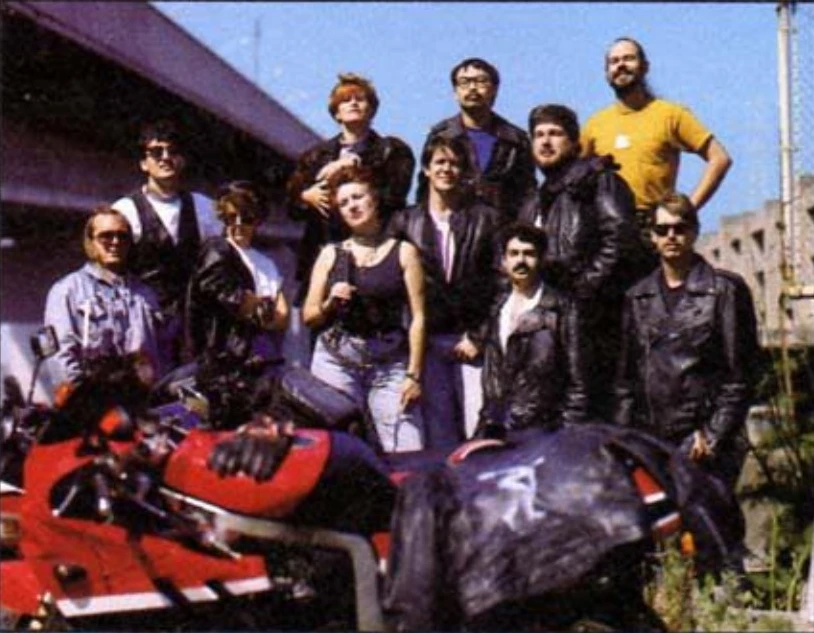
After Geisler’s months of work on the road effect, Stein and Mey worked with him on optimizing it in 1990, as it had debuted at CES that year but had performed poorly with dropped framerates. The game nearly had its plug pulled by EA executives on multiple occasions, but the team stood up for it because they knew what they had.
Geisler went to bat for the team as well and convinced EA executives that what they were making wasn’t a pure racing game, nor was it a combat game. It was a genre all of its own.
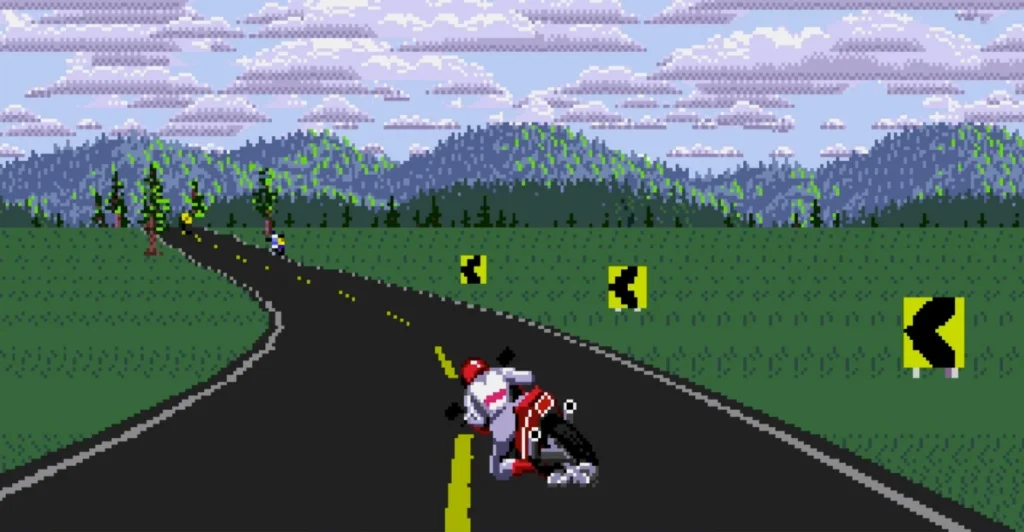
And it truly was a unique game. Geisler recalls how much fun it was to work with creative liberty in the game making impossible things completely possible within the game. “I think a lot of the inspiration for the game was just having some humor in it. We’d throw out funny ideas ‘wouldn’t it be cool to do this?’ and we’d just do it. Randy was really instrumental in getting us more time to do what we wanted on the project. Management tried to kill it twice, but he and Carl believed in it. Also, Richard Hicks got it approved (he was the director of development), so he knew I could technically do it.”
Nearing the end of development, the team also opted to change the name of the game, from the mouthful Road Rash on Mulholland Drive to just Road Rash.
While the art team worked on new sprites, animations and optimizations, Geisler got to work creating new maps and courses for riders. With the code for the road effects so well optimized, Geisler says he, “could have mapped out all of the California coast” and fit it all in the Genesis’ memory.
Success Nobody Told Geisler About
After a year and a half in development, Road Rash launched to critical and commercial success in September of 1991. GamePro gave it a perfect rating, and it sold over 1 million copies worldwide.
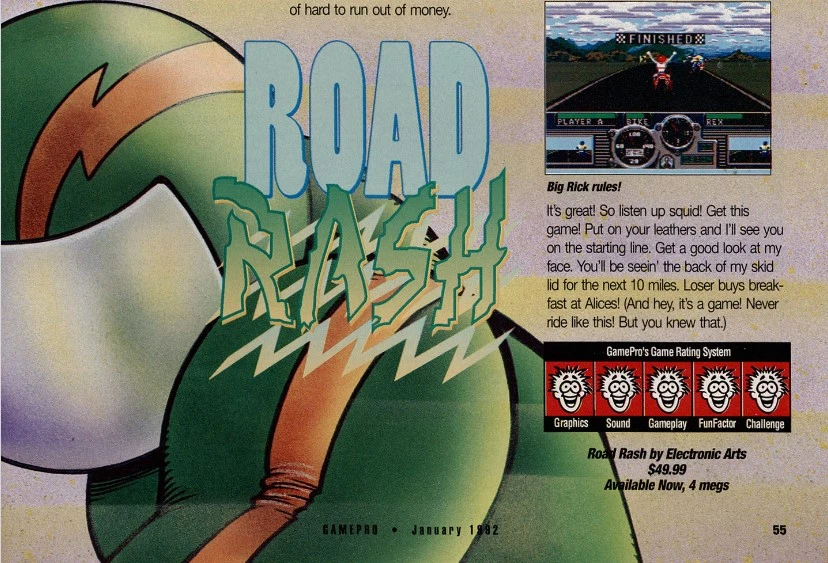
However, Geisler hadn’t even realized the impact the game had made.
“EA never really told me it was that much of a success. I mean, they gave me a couple of plaques and awards and stuff at the company annual meetings, but I never really knew it was a big deal until maybe the later 2000s, when someone told me a story about how people used to say, ‘Oh yeah, that’s the guy who made Road Rash.’ And my daughter’s boyfriend (who’s her husband now, actually) was impressed that her dad made Road Rash. So I never really knew how popular it was. I knew it was successful, but I didn’t know how much it affected people’s lives, or that they were really playing it a lot. That’s just been a real nice bonus.”
For Geisler, Road Rash was just him having fun with a great team.
“I feel very fortunate. I had just done the game for myself, because I wanted to play that type of game. It’s really cool to have had the chance to make the game I wanted to play. I never felt like I was working at all, even though I was commuting 200 miles a day.”
Road Rash II Development
The success of Road Rash heralded a sequel, which EA slated to be released for the 1992 Holiday Season. That gave the team less than a year to create the sequel. Luckily, they could build off of the work they had already done.
Geisler and Breen would serve as Designers on the Road Rash II, and Geisler would also lead programming on it. They expanded on the formula that worked so well in the original, adding more locations that went across the United States instead of just California, and improved the computer AI to be less repetitive and more individualistic.
The biggest change in the game was probably its most defining. Because it could use an 8-megabit cartridge size instead of a normal cartridge’s 5-megabit size, the team had room to add a two-player mode. Now friends and siblings could beat the hell out of each other with chains and clubs.
Geisler would later tell Retro Gamer, “Essentially, the main game was the same engine, but the big new tech was the multiplayer split-screen, which added a whole new dimension.”
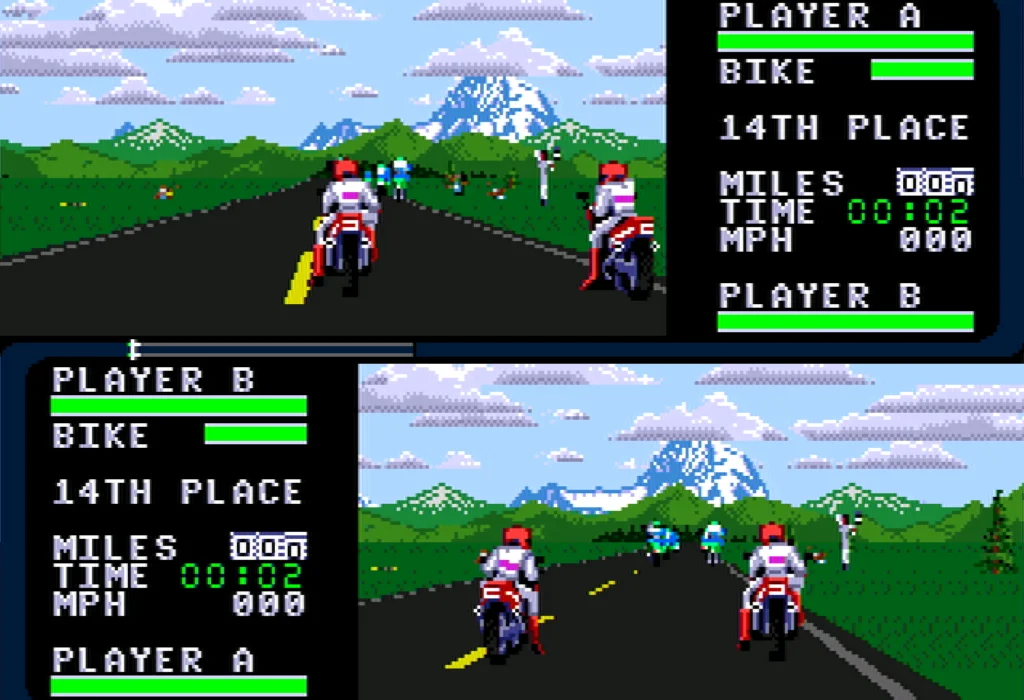
Granted, the two-player mode couldn’t handle as much detail as the single player mode, the simple addition of it helped the sequel outsell the original.
Road Rash 3 Almost Doesn’t get Made
After Road Rash II launched, Geisler was going to leave EA. He had accepted an offer from Crystal Dynamics, which was a spinoff from the 3DO company and focused on making games for the 3DO. The job enticed Geisler because he would be working on much more powerful hardware than the Genesis, which he felt they had already tapped out performance-wise. EA asked him what it would take to keep him and Geisler named his price. EA met it, and Geisler stayed on and was put on a team with designer Amy Hennig to work on a basketball game featuring Michael Jordan. However, it became apparent that the team and Dan didn’t fit quite right. In Dan’s words, “there just wasn’t that synchronicity on the team that you need.”3
Geisler took matters into his own hands, and one day tracked down Bing Gordon, who was VP of Marketing for EA, and said, “You want Road Rash 3?” When Gordon replied that he would, Geisler said, “Yeah, I’m thinking we could do that quicker than we’ll get this other (Michael Jordon) game out, and we’ll beat ’em to the market, and they’ll go to the bargin bin and we’ll go to the top of the charts.”
Gordon was convinced and green-lit Road Rash 3.
For Road Rash 3 Geisler stepped down from the design role, but was still the lead programmer on the project. The third installment of the franchise would still be on the Genesis, but the original Road Rash would also be ported to the 3DO and Sega CD during the same time period. Building off the second game, this third installment would feature courses around the world and new weapons such as a mace, a crowbar and a cattle prod. The graphics of the game were also overhauled based on the digitized characters that were being made for the 3DO and Sega CD ports.
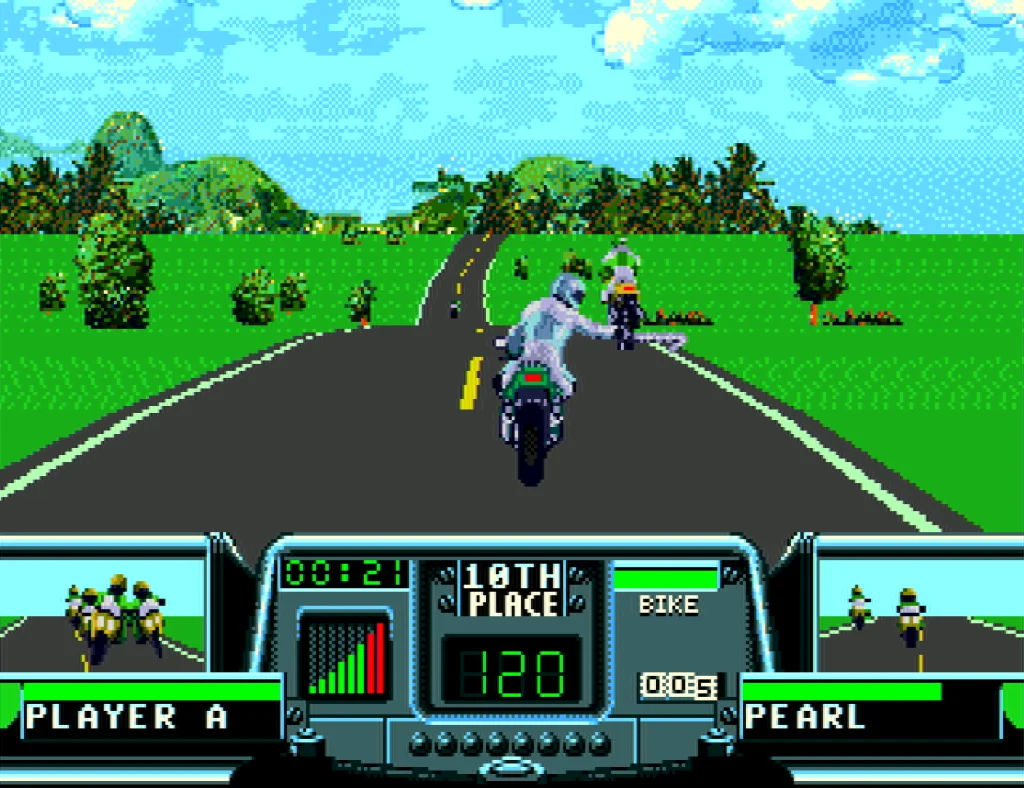
In March, 1995 Road Rash 3 was released, and outsold both of its predecessors.3
And the Michael Jordan game that Geisler was supposed to be working on? It was Michael Jordan: Chaos in the Windy City, a creative, yet mediocre basketball/platformer that got mixed reviews.
Leaving EA and Potential Grand Theft Auto Muse
Having fulfilled his end of the deal, Geisler left EA a few months after the launch of Road Rash 3.
Geisler was now a known quantity in the gaming world, and one of his friends, Russ Patterson, was working on a new game with Dan Houser and his brother Sam (who would both later help release a vehicular combat game called Grand Theft Auto, see, I told you we’d come back to it). Geisler showed Patterson the code base to Road Rash, which Patterson in part may have used to create Courier Crisis for the Playstation and Sega Saturn (Geisler is giving a special thanks credit in the game). At that time Geisler was working on his own concept for a game.
Geisler describes the game as, “I wanted to do that sci-fi project with [sci-fi writer] Bruce Sterling, so Russ (Patterson) had access to my code base and prototype and stuff. It was going to be an open-world driving game in Seattle. The sci-fi aspect was a hacker solves his girlfriend’s genetic research problem, and he and his girlfriend go on the run in the streets of Seattle. Anyway, we talked about things like that, and I had a little prototype I showed him. I don’t know — maybe that gave the Houser brothers an idea. I’m not saying they stole anything, but you know, like any idea, it’s always a compliment to kick off some other idea. Somebody said that’s the way creativity works — we all stand on the shoulders of greatness.”
A Seattle “Vacation”
Geisler met a programmer that told him to come interview for a position up in Seattle. At the very least, Geisler thought he could get a free vacation out of the deal for him, his wife and their three kids. So he interviewed and was hired by Microsoft.
Geisler recounts, “I got up there, and the first time I sat next to Gates and Steve Ballmer at a company meeting — about a month after I’d been there — I knew I was going to leave. I couldn’t work with those guys. All they wanted me to do was get patents. Instead of making games, I was going to do the interactive game channel — kind of like the Sega Channel, but with all brand-new games. I was designed to make games, and they just wanted me to file patents.”
On the Move Again
With Microsoft in the rear-view mirror, the next stop was New Wave Entertainment, which Michael Mendheim had started. Geisler and Mendheim became (and to this day still are) good friends. They began working on a World War II simulation. While there, Geisler got to work with Richard Hicks, who was the ex-director of technology at EA for the Road Rash series. While talking one day, Geisler realized that Hicks had never received one of the special golden cartridges the team got for selling over 1 million copies of Road Rash. So Geisler gave him one of his own (he still had three platinum cartridges at home).
The time at New Wave Entertainment was short-lived though, as funding for the game ran out. However, another game developer was just down the road from New Wave, so Geisler interviewed and was given the job of a Senior Lead Engineer.
The company was Sega.
Inmates Run the Asylum
Sega was working on a new football game and Geisler became the Senior Lead Engineer on it working alongside Paul Vernon who had done the graphics on Road Rash and the ill-fated Michael Jordan: Chaos in the Windy City. Joining Vernon was fellow artist Michael Mangano. As the team began working on the project, Geisler also talked with Sega of America legend Ed Annunziata (creator of Ecco the Dolphin, and producer of the Genesis hits X-Men and Kolibri) as they both worked on projects. One day, Geisler was out back and randomly met guitarist Ronnie Montrose, who he had seen at one of his first concerts. “It was a brush with greatness,” Geisler tells me, “I couldn’t believe it. So Ed hired him to do the soundtrack for a game called Mr. Bones, which featured a lot of blues — that’s what Ronnie told me he was getting into, the blues.”
While at Sega, it became apparent that things at Sega of America were not going well. The lack of communication between Sega of Japan and Sega of America are well documented, but Geisler experienced them first-hand. “The inmates were finally running the asylum — and Japan wouldn’t even give us any information on what they called the ‘Black Belt,’ soon to be released as the Dreamcast.”
It was obvious that Sega was struggling, and the folks at 3DO came along and Geisler took the opportunity to move on from the disfunction at the former gaming powerhouse.
3DO Years
Leaving the sinking ship that was Sega, Geisler boarded the 3DO life raft (a company that itself had seen its hardware fail, but transitioned to a software developer). Interestingly, 3DO was founded by former EA founder, Trip Hawkins.
It was now 1998, and after hopping around the industry trying to find a fit for a few years, Geisler settled in at the 3DO. His first project was with his friend Michael Mendheim, who had also landed at 3DO after New Wave Entertainment. The project was a Nintendo 64 release called BattleTanx.
As the years went on, Geisler and Mendheim worked together on a new series: Army Men: Sarge’s Heroes, which Geisler served as the Technical Director on. The toll of the game came at a price: in the last two months of development, the team was spending 15-16 hours at the office trying to complete it due to a lack of resources at 3DO. Mendheim would later say of Geisler, “Dan was a rockstar and acted like one. All the girls solved him because he was always the smartest and best-looking guy in the room, complete with the ‘bad boy’ attitude.”
Game Development Mercenary
After five years at 3DO, Geisler decided to take his show on the road and become a consultant, helping out Black Ops Entertainment with Terminator 3: Rise of the Machines and AND 1 Streetball. He then joined Sony for a year to program Resistance: Fall of Man. He also spent time at Midway, designing engineering tools for the Unreal3 Game Engine, before going to Activision to work on Kung Fu Panda and audio tools. Finally, he went to Warner Bros. where he designed advanced game AI.
With a career spanning 40 years and having worked in nearly every large gaming studio imaginable, Geisler says, “I feel like Forrest Gump of the game in industry except without the Bubba Gump cash, which is fine with me.”
In 2026, Geisler officially retired from corporate life. He now enjoys making games with his son who has a startup called Blamo! where anyone can create their own game.
Special Thanks!
I want to give Dan Geisler a huge THANK YOU for sharing his story with me. Seeing behind the curtain of how games were made is the reason Retro Gaming Geek exists, and hearing about the ups and downs that Dan went through tells me that it’s much easier to write about these things than to have actually lived through it. But I’m forever grateful to him, not only for sharing his time with me, but for sharing a part of himself with all of us in the games that he developed.
References
- Retro Gaming Geek Interview with Dan Geisler August – September, 2026
- Vette! Compute! Choice pg. 84-86 Nov. 1989
- Retro Gamer No. 166, pg. 20-27
- Retro Gamer No. 88, pg. 44-51
- Hickey Jr., Patrick (2022). “Michael Mendheim, Army Men: Sarge’s Heroes“. The Mind Behind PlayStation Games. McFarland and Company. pp. 74–80.